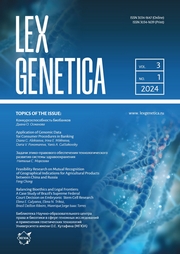
Lex Genetica is a new and the first in Russia interdisciplinary, peer-reviewed, completely open access legal journal focused on the areas of the legal regulation of genomic research, application of genetic technology as well as aspects at the intersection of law, biosciences, philosophy including genetics, bioethics, agriculture, food technologies and other fields of science.
The journal is established and supported by the Kutafin Moscow State Law University (MSAL). Center for Law & Bioethics of MSAL is responsible for editing and issuing the journal.
Lex Genetica is published as one volume with four issues per year, with new articles posted online on an ongoing basis.
The start year of publishing is 2022.
Current issue
Lex Genetica: Interdisciplinary Research
In the context of pandemic threats, global population aging, and recurring health system crises, including those affecting developed countries, the importance of disease prevention is steadily increasing. Health policies worldwide are placing greater emphasis on preventive medicine and the promotion of healthy lifestyles. New approaches to the concept of public health are emerging, along with the development of healthcare models that rely on digital algorithms for processing public health data. These technologies can facilitate the development of measures to improve population health and promote health-saving policies with an emphasis on wellbeing and healthy aging.
In this study, the author sets out to analyze the social aspects of implementing preventive healthcare mechanisms from the legal perspective. Preventive medicine is not a new phenomenon in Russia. Thus, during the Soviet era, preventive healthcare measures in the form of vaccination, hardening of the body, and systematic physical exercise constituted the cornerstone of public health policy. Today, significant attention is paid to population health screening and the early detection of diseases. Meanwhile, contemporary preventive healthcare relies on advanced digital technologies, thus acquiring new dimensions beyond traditional measures such as medical examinations and immunoprophylaxis. This gives rise to new legal challenges that require analysis.
Preventive medicine is inherently personalized, since it takes into account an individual’s physiological, biological, anatomical, mental, and behavioral characteristics. At the same time, preventive strategies may also be population-based, addressing the shared geographical, social, genetic, and demographic characteristics of specific communities. This contributes to the emergence of a new healthcare paradigm that aims to deliver comprehensive, personalized medical care through the application of advanced technologies. Its successful implementation requires an appropriate legislative regulation that not only keeps pace with technological innovation but also safeguards the constitutional rights and freedoms associated with health protection.
As a result of the study, the main features that characterize the development of preventive medicine in Russia from the legal perspective were identified.
Lex Genetica: Private-Law Dimension
This article addresses the legal problems associated with the posthumous use of biological reproductive material (gametes, reproductive organ tissues, and in vitro embryos) preserved within assisted reproductive technology (ART) programs. The conducted review of 14 judicial acts of 2018–2026 identified two major types of disputes: the claim of a surviving partner for the posthumous use of biomaterial and the claim of third parties (parents, other relatives) for the right to dispose of the biomaterial of the deceased. The author shows that the outcome of such cases is determined primarily by the doctrinal approach of the court regarding the role of the lifetime declaration of will, rather than by the factual circumstances or the wording of the informed voluntary consent (IVC). The systemic impossibility of protecting the rights of third parties to the biomaterial of the deceased under the existing closed list of indications for ART is revealed. Particular attention is paid to oncofertility as a specific context of posthumous reproduction. The authors argue for the introduction of a dedicated institution of a special (reproductive) declaration of will and identify the key directions for legislative reform, including amendments to Federal Law No. 323-FZ, the Civil Code of the Russian Federation, and the ART Procedure.
The author sets out to examine the legal status of biobanks in Russian and foreign legal systems. The legal regulation of biobanking is shown to remain insufficient. The author analyzes existing approaches to the nature of biobanks and concludes that a biobank should be regarded a legal entity with special legal capacity. It is proposed to define a biobank as an organization (or its structural subdivision) that carries out all or some activities of the following activities: collection, processing, acquisition, storage, transfer, and research of human biological materials, as well as biomaterials obtained from animals, plants, and other organisms, along with the related information for medical, scientific, educational, and other purposes. The identified gaps in the legal regulation of biobanks can be addressed through the adoption of either a law on biobanks or a comprehensive law on genetic technologies.
Lex Genetica: Comparative Legal Analysis
Objective. This article analyzes the approaches to the legal regulation of genetic information and human genetic data in the People’s Republic of China. The study is motivated by the forthcoming entry into force, on September 1, 2026, of amendments to Federal Law No. 86-FZ “On State Regulation in the Field of Genetic Engineering Activities”, which introduce the concept of human genetic data and establish restrictions on their cross-border transfer. This makes it necessary to examine foreign experience, particularly that of China, which has established a system of legal regulation in this area, in order to assess the applicability of its positive practices in the Russian Federation.
Methods. The research employed both general research (analysis, synthesis, generalization) and special legal methods, such as comparative legal, formal legal, and dogmatic analysis. A review of doctrinal sources by Russian and Chinese authors, as well as regulatory legal acts of the PRC, including the Biosafety Law, the Personal Information Protection Law, the Regulations on the Management of Human Genetic Resources, and other subordinate legislation was conducted. Additionally, empirical data on the dynamics of administrative licensing in 2021–2024 were examined.
Results. The Chinese model of genetic data regulation is based on the principle of state sovereignty, which permeates all levels of normative regulation. The legislation employs a dual structure of “human genetic resource materials” and “human genetic resource information,” each of which has its own legal regime. Genetic data simultaneously fall under the scope of biosafety legislation, personal data protection legislation, and medical big data legislation, thus creating a multi-layered system of requirements. The circulation of resources is carried out predominantly under a permissive (authorization) procedure, while cross-border transfer and access by foreign entities are subject to the strictest control. The liability system includes administrative fines, criminal prosecution, and disqualification. At the same time, the subordinate regulations adopted in 2023–2025 reflect a trend towards rationalization of regulation (narrowing the scope of licensing, simplifying procedures for clinical trials).
Conclusion. China’s experience may be useful for the Russian Federation in developing a comprehensive legislation framework on genetic technologies. The need to adopt a basic federal law that would combine norms on the protection of indi-
vidual rights and ensuring national security, establish clear criteria for the cross-border transfer of genetic data, and provide effective mechanisms for control and liability is argued.
Genetic data is a highly specific type of personal data, being inalterable, inherently family-like, capable of being used to predict future health states, and incapable of being completely anonymized. With the growing strides India is making towards its genomic goals defined under the Genome India project and the general push for precision medicine, the current legal architecture to regulate genomic data has become a pressing constitutional, statutory, and ethical concern. This article engages in a doctrinal analysis and comparative legal analysis of the existing
regulatory framework of genomic data in India, namely the Justice K.S. Puttaswamy (Retd.) v Union of India (2017) case, the Digital Personal Data Protection Act, 2023, the Digital Personal Data Protection Rules, 2025, and the Indian Council of Medical Research (ICMR) National Ethical Guidelines, 2017.
The analysis places India’s framework in a comparative perspective, which is based on the General Data Protection Regulation of the European Union, the Genetic Information Nondiscrimination Act of the United States, as well as institutional governance models of the United Kingdom Biobank and Genomics England. The study points out six key regulatory gaps in the Indian regulatory landscape: the absence of a sui generis special category for genetic data, the absence of an adequate informed consent architecture suitable for longitudinal genomic research, the lack of statutory storage and retention limits, the lack of an anti-genetic discrimination statute, structural vulnerabilities in cross-border data transfer governance, and the total absence of any statutory frameworks for AI-driven predictive genomics. The article concludes with evidence-based recommendations for the enactment of a dedicated Genetic Data Protection Act, a Genetic Non-Discrimination Act, and a National Genomic Data Regulatory Authority.
Lex Genetica: Аcademic Digest

ISSN 3034-1647 (Online)